Projects
Ngramble
A familiar word. An unfamiliar slice. Five turns to put the whole thing back together.
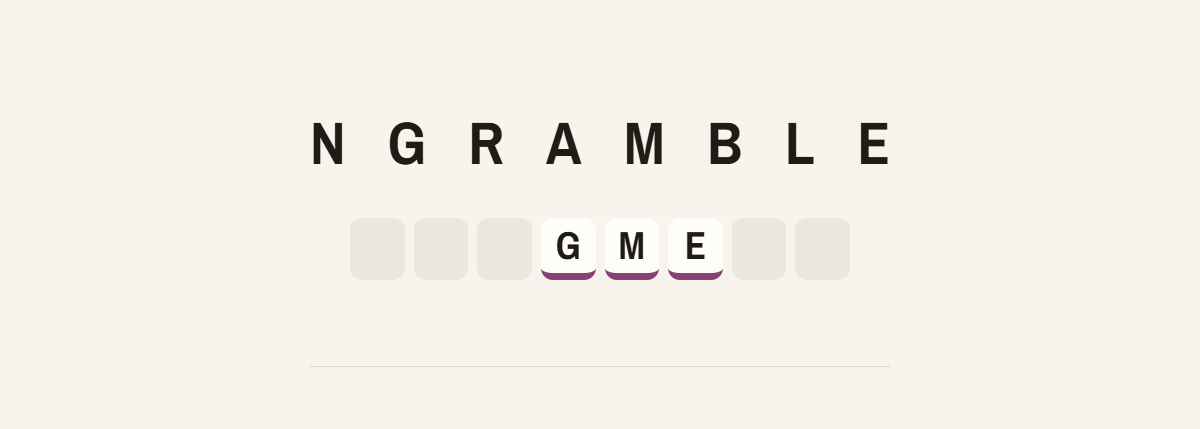
Ngramble started late one night on holiday. I was reading a book when the word candlelight broke across two lines. The second line opened with DLEL—a deeply odd-looking fragment hiding inside an entirely familiar word.
I stopped reading and started wondering how many other ordinary words became strange when you hid their beginnings and endings. That was the whole genesis of the game: take something familiar, expose the least helpful bit of it, and ask the brain to put the word back together.
Ngramble is now a live, mobile-first daily word game at ngramble.com. Building it was mostly a quick back-and-forth with Claude, Claude Design and Codex: play what came back, say what felt wrong, tighten the rule or interface, and go around again. It was not an arduous build. That ease is part of the point—and part of why it belongs on EMAH.
The mechanic
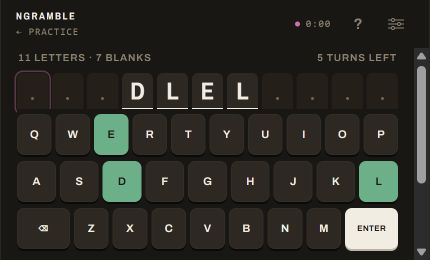
You get five turns. On each turn you can either submit a valid whole-word guess or reveal one chosen blank. Guesses give green, yellow and grey feedback. A reveal gives certainty, but spends the same scarce turn. The fifth turn must be a word guess.
That shared budget is the important bit. A speculative guess can return much more information, but a reveal lets you attack the exact part of the word your brain cannot see. The starting fragment, revealed letters and green letters become fixed facts; typing simply skips over them.
The goal is not to punish people for taking help. It is to create a clean little decision: spend a turn buying certainty, or trust the word that is beginning to form in your head.
Designing around the middle
The first product problem was not drawing tiles. It was deciding what kind of game this actually was. Ngramble is mostly a recall game, not a miniature crossword or a pure deduction system. The fantasy is the moment a familiar word suddenly resolves around an unfamiliar fragment.
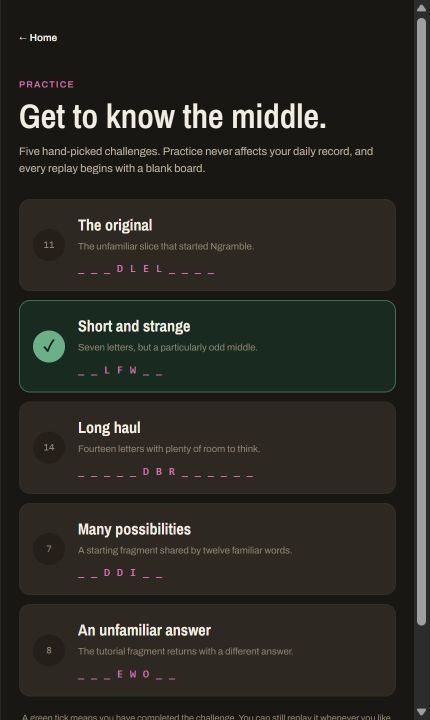
That shaped the content rules. A starting fragment has to sit inside the word, with enough hidden material on both sides to break the usual recognition pattern. It also needs to lead somewhere fair. An obscure answer can make a difficult puzzle, but it rarely makes a good one.
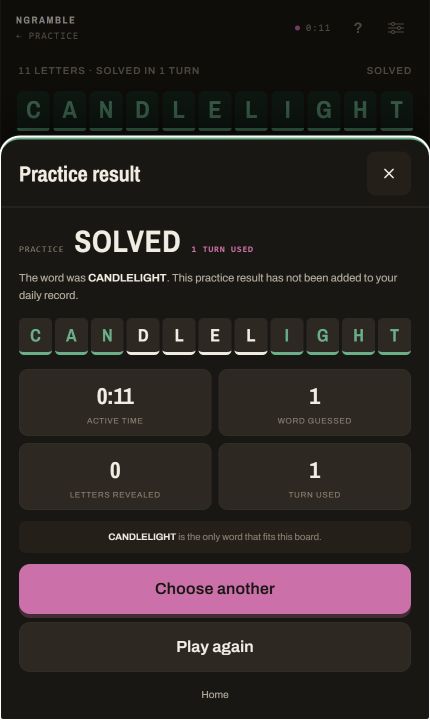
It also shaped the interface. Fixed letters cannot be contradicted. Invalid words do not spend a turn. The board gives repeatable feedback rather than quietly refusing input. On a phone, every tile has to remain legible without wrapping, and the keyboard has to stay stable while the result sheet arrives.
The content system behind a daily game
A daily word game is partly an interface and partly an editorial operation. Ngramble has a deterministic generation and selection pipeline, an auditable schedule and explicit rejection records. The current schedule covers 1,529 dates and draws from answer lengths between seven and fourteen letters.
The content work became more exact as the game matured. Candidate fragments are scored for how recognisable, strange and ambiguous they are. Scheduling rules avoid exhausting runs of unusually long words. Early puzzles can be pinned while the remaining bank is regenerated reproducibly.
Future answers are kept on the server rather than bundled into public JavaScript. The client requests the current puzzle for the player's local date and timezone. That is not an anti-cheat system—there is no prize to protect—but it stops the whole editorial schedule becoming one convenient download.
Turning the mechanic into a product
The work after the first playable version was mostly about state, continuity and trust. Started games survive a refresh. A tab crossing midnight gets a short grace period rather than changing the puzzle beneath the player. Practice reuses the real game components but remains isolated from the daily record. A completed game always keeps its result and sharing controls available.
Personal progress lives only in the browser. There are no accounts, no leaderboard and no cross-device identity. Anonymous gameplay counts can be switched off without affecting the game. The record is intentionally modest: played, wins, streaks, clean solves, turns, reveals and active solve time.
The accessibility foundation became part of the product rather than a clean-up pass. The game supports physical and on-screen keyboards, reduced motion, light and dark appearances, a colour-blind palette, optional sound and haptics, visible focus and screen-reader labels for the state of each tile.
Where the AI flag fits
Ngramble is marked AI because almost the whole build happened through conversation with Claude, Claude Design and Codex. I moved between them, played what came back, reacted to it and redirected the next pass. The loop felt closer to editing and art direction than a conventional software build.
That loop still produced a surprisingly broad product: interaction design, accessibility passes, puzzle analysis, deterministic content tooling, state edge cases, analytics, deployment and a fairly obsessive audit trail. Product judgement stayed in the loop, but implementation rarely felt like the limiting factor.
This is the kind of project EMAH exists to document. The visible object is compact. The collaboration behind it makes a much larger level of finish possible for one person, while creating a new need for discipline around context, verification and what counts as done.
What I learned
The surprising lesson was not that a small game concealed a punishing amount of work. It was how casually a fairly complete daily product could emerge from repeated conversations. The mechanic took very little space to explain; the surrounding system grew through quick loops of playing, noticing and asking for the next change.
The strongest design decisions were subtractive. No accounts. No archive. No leaderboard. No separate hard mode. No currency wrapped around reveals. The rules enforce useful constraints directly and leave the player with the word.
The implementation no longer feels like the scarce thing. The remaining test is the one no agent or document can answer: whether people want to come back tomorrow. The product is live, the content runway exists, and now real play has to do the talking.
Project facts
- Status: Live
- Type: Project
- Build mode: AI-assisted product design and implementation
- Platform: Mobile-first web app hosted on OpenAI Sites
- Core decision: Five turns shared between whole-word guesses and chosen-letter reveals
- Personal data model: Local browser storage, no account and no leaderboard
- Public site: ngramble.com